
5 Fastest Hypercars 2026: The Ultimate Speed Battle
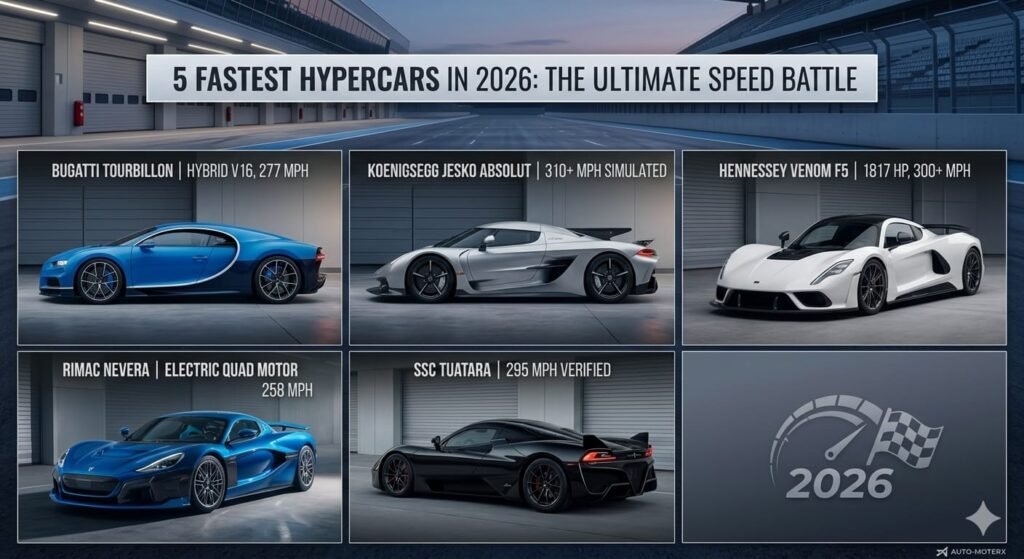
The world of hypercars in 2026 stands at a turning point where the limits of speed seem to have vanished. Leading the list of the Fastest hypercars 2026 is the Koenigsegg Jesko Absolut, emerging as the undisputed ‘Speed King’ with a simulated top speed of 310 mph+ (500 km/h). Close on its heels, the Yangwang U9 Xtreme has left everyone stunned by clocking 308 mph, marking it as a groundbreaking marvel of Chinese engineering.
The Legend: Bugatti Chiron Super Sport
The Bugatti Chiron Super Sport remains the gold standard for luxury and engineering excellence in the automotive world. Powered by a massive 8.0-liter quad-turbocharged W16 engine, this beast produces a staggering 1,578 horsepower. Unlike many of its rivals that focus solely on raw speed, the Chiron offers an unparalleled level of refinement and comfort. It famously became the first production car to break the 300 mph barrier, reaching a verified top speed of 304.77 mph. Even as new challengers emerge among the fastest hypercars 2026, the Chiron’s legacy as a ‘Luxury Missile’ ensures it stays at the top of every collector’s wish list
The Speed King: Koenigsegg Jesko Absolut
The Koenigsegg Jesko Absolut is engineered with one singular goal: to be the fastest car the world has ever seen. Unlike the standard Jesko, the Absolut version is stripped of its massive rear wing to achieve a remarkably low drag coefficient of just 0.278 Cd. Under the hood, it features a 5.0-liter twin-turbo V8 engine that produces up to 1,600 horsepower when running on E85 fuel.
What truly sets it apart among the fastest hypercars 2026 is its revolutionary 9-speed Light Speed Transmission (LST), which allows for near-instant gear shifts. With a simulated top speed of over 330 mph, the Jesko Absolut is not just a car—it is a masterpiece of Swedish aerodynamics designed to dominate every straight-line battle.”
Koenigsegg Jesko Absolut vs Bugatti Chiron: The Weight Gap
When discussing top speed, horsepower alone isn’t the whole story; the real secret lies in the ‘Power-to-Weight Ratio.’ While most enthusiasts focus on engine output, few realize the massive weight difference between these two giants. The Koenigsegg Jesko Absolut weighs a mere 1,390 kg, whereas the Bugatti Chiron Super Sport tips the scales at approximately 1,995 kg.
This staggering 600 kg gap is exactly what gives the Jesko the edge in straight-line acceleration and ultimate velocity. While the Chiron is often described as a ‘Luxury Missile’ built for refined power, the Jesko is a ‘Precision Instrument’ strictly engineered to slice through the air with minimal resistance
The American Powerhouse: Hennessey Venom F5
The Hennessey Venom F5 is a testament to American engineering and pure mechanical aggression. Named after the highest category of tornado, the F5 is powered by a custom-built 6.6-liter twin-turbocharged V8 engine, aptly nicknamed ‘Fury.’ This massive powerplant delivers an astonishing 1,817 horsepower, making it one of the most powerful internal combustion production cars in existence.
Unlike its competitors, the Venom F5 focuses on a raw, driver-centric experience without the aid of hybrid systems. As a top contender for the fastest hypercars 2026, Hennessey has designed this car with a lightweight carbon-fiber chassis to target a top speed of over 311 mph (500 km/h). Its combination of extreme power and a low curb weight makes it a formidable rival in the quest for world-speed records
The Aerodynamic Marvel: SSC Tuatara
The SSC Tuatara is a masterpiece of American hypercar engineering, designed specifically to dominate the world’s longest straights. Its sleek, fighter-jet-inspired body boasts an incredible drag coefficient of just 0.279, allowing it to cut through the air with unmatched efficiency. At its heart lies a 5.9-liter twin-turbo V8 engine that produces a massive 1,750 horsepower on E85 fuel.
Having already achieved a verified two-way average speed of 282.9 mph, the Tuatara remains a top-tier challenger in the race for the fastest hypercars 2026. What makes this car truly unique is its high-tech stability and carbon-fiber construction, ensuring that it remains planted even as it approaches the elusive 300 mph mark. For those who value extreme aerodynamics and raw American power, the Tuatara is a legendary contender
The American Challengers: Venom F5 vs. SSC Tuatara
In the fierce battle for the fastest hypercars 2026, the American duo of Hennessey Venom F5 and SSC Tuatara stands as a formidable threat to European dominance. The Hennessey Venom F5, powered by its legendary 6.6L twin-turbo ‘Fury’ V8 engine, delivers a massive 1,817 horsepower, specifically engineered to chase the elusive 311 mph (500 km/h) mark. On the other hand, the SSC Tuatara relies on extreme aerodynamics with a drag coefficient of just 0.279, enabling its 5.9L V8 engine to push out 1,750 horsepower.
While Hennessey focuses on a raw, visceral driving experience—even introducing a manual ‘F5-M’ variant—SSC focuses on precision and stability, having already verified a top speed of 282.9 mph. Together, these two machines represent the pinnacle of American performance, proving that raw power and cutting-edge carbon-fiber engineering can challenge the world’s most established speed records
The Electric Revolution: Rimac Nevera
The Rimac Nevera is the car that proved electric vehicles could not only compete with but dominate the world of internal combustion engines. This Croatian masterpiece is powered by four independent electric motors, one for each wheel, delivering a jaw-dropping 1,914 horsepower and 2,360 Nm of torque.
What makes it a standout among the fastest hypercars 2026 is its near-instantaneous power delivery, allowing it to rocket from 0 to 60 mph in just 1.74 seconds. While its top speed of 258 mph (412 km/h) is slightly lower than its petrol-powered rivals like the Jesko, its precision-tuned All-Wheel Torque Vectoring system ensures that it handles corners with incredible agility. The Nevera isn’t just a hypercar; it’s a technological milestone that marks the beginning of a new, silent era of extreme performance
Conclusion: The Future of Speed
The race for the fastest hypercars 2026 has shown us that whether it’s the raw V8 power of Hennessey and SSC, the refined luxury of Bugatti’s V16, or the silent electric thrust of the Rimac Nevera, engineering has no limits. As we move forward, the battle is no longer just about reaching 300 mph, but about how much technology and precision can be packed into these road-legal machines. One thing is certain: 2026 is the year where the dream of 500 km/h is finally becoming a reality for the ultimate speed lovers
FAQ
Why Does the Koenigsegg Jesko Use E85 Fuel?
While the Koenigsegg Jesko is a beast on standard gasoline, it only reaches its full potential of 1,600 horsepower when running on E85 biofuel. But why is this fuel so critical for the fastest hypercars 2026? The answer lies in two main technical advantages: Octane Rating and Cooling Properties.
High Octane Rating (105+): E85 has a much higher octane rating than premium pump gas (which is usually 91-93). This allows the Jesko’s twin-turbo V8 engine to run much higher boost pressures without the risk of ‘engine knock’ or premature detonation. More boost directly equals more power.
Which is the fastest production car in the world in 2026?
Currently, the Koenigsegg Jesko Absolut holds the title as the fastest theoretical production car with a simulated top speed of over 330 mph (531 km/h). However, the Yangwang U9 Xtreme and SSC Tuatara are also top contenders with verified high-speed runs.
Can the Rimac Nevera beat a Bugatti Chiron in a drag race?
Yes, in a short-distance drag race, the Rimac Nevera usually wins due to its instant electric torque and all-wheel-drive system, hitting 0-60 mph in just 1.74 seconds. The Chiron is faster in long-distance top-speed runs but takes longer to accelerate.
Is the Bugatti Tourbillon faster than the Chiron?
The Bugatti Tourbillon is designed with a new hybrid V16 engine. While its limited top speed is around 277 mph (445 km/h), its acceleration and technology are superior to the older Chiron models.
Why are most hypercars switching to Hybrid or Electric power?
Manufacturers are moving towards Hybrid (like the Tourbillon) and Electric (like the Nevera) to achieve instant torque and comply with stricter emission laws while still breaking speed records.